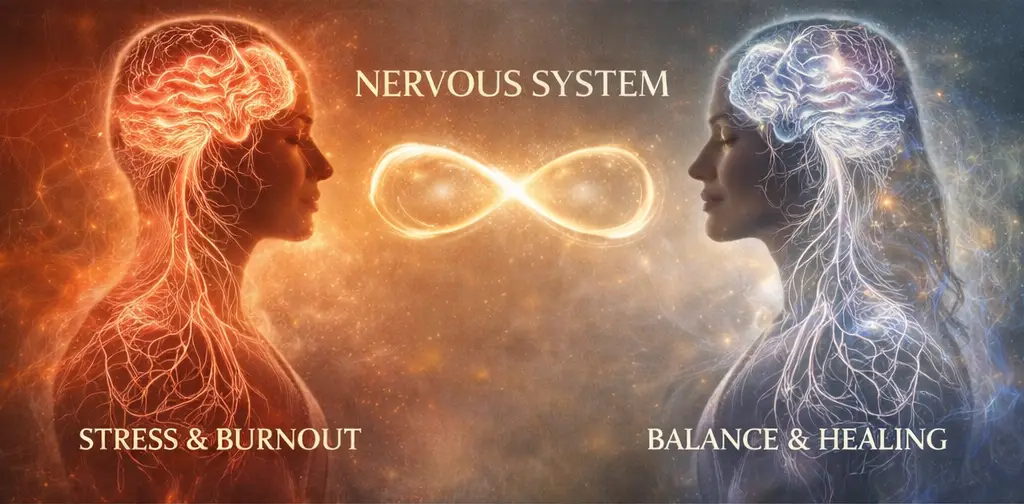
Burnout doesn’t always arrive loudly.
Sometimes it shows up quietly — as constant tiredness, stubborn weight changes, mental fog, or the feeling that no matter how much effort you put in, your body is no longer responding the way it used to.
Many people try to fix burnout by working harder on their habits. Better food. More workouts. Stronger discipline.
But burnout is not a motivation problem.
It is a nervous system problem.
And until we understand that, balance remains out of reach.
Burnout Is Not Just Mental Exhaustion
Burnout is often described as emotional or mental fatigue. But in reality, it is a full-body experience.
It affects:
- Energy levels
- Hormonal balance
- Metabolism
- Focus and clarity
- Emotional resilience
At the centre of all this is the nervous system — the system responsible for how safe, alert, or overwhelmed we feel in our bodies.
When the nervous system is constantly under pressure, the body adapts for survival, not for health.
The Nervous System’s Job Is Protection, Not Performance
The nervous system is designed to keep us safe.
When it senses threat — emotional, mental, or physical — it shifts the body into survival mode. This is often called fight or flight.
In modern life, the “threats” are rarely physical. They are deadlines, expectations, pressure to perform, unresolved emotions, and the inability to truly rest.
When this state becomes chronic, burnout follows.
The body does exactly what it’s meant to do — it conserves energy, holds on, and prioritises survival.

How Burnout Affects Health at a Deep Level
When the nervous system remains dysregulated for long periods, the body begins to change its priorities.
Digestion slows.
Recovery weakens.
Sleep becomes lighter.
Inflammation increases.
Health issues don’t always appear suddenly. They build quietly.
People often say, “I’m eating well, but my body isn’t responding.”
Or, “I work out regularly, but my energy keeps dropping.”
This isn’t failure. It’s communication.
The body is responding to stress, not habits.
The Nervous System and Weight: What Most People Miss
Weight changes during burnout are not about lack of discipline.
When the nervous system is in constant alert mode, the body becomes protective. It holds on to energy because it doesn’t feel safe enough to let go.
This can show up as:
- Weight gain despite healthy eating
- Difficulty losing weight
- Cravings driven by stress, not hunger
- Slowed metabolism
Trying to control weight without addressing nervous system regulation often leads to frustration and self-blame.
But the body isn’t resisting you.
It’s protecting you.
Focus, Brain Fog, and Mental Exhaustion
One of the clearest signs of nervous system overload is loss of focus.
When the system is busy scanning for danger — even subtle danger — the brain shifts away from creativity, clarity, and long-term thinking.
This is why burnout often comes with:
- Difficulty concentrating
- Forgetfulness
- Decision fatigue
- Mental fog
Focus is not a productivity skill.
It is a sign of internal safety.
A Personal Reflection
I’ve worked with people who were incredibly capable, driven, and intelligent — yet deeply frustrated with themselves.
They thought something was wrong with their discipline.
What was actually happening was far more human.
Their nervous systems had been carrying too much for too long.
Once we stopped trying to “fix” behaviour and began supporting regulation, things shifted — gently, sustainably, and without force.
From Burnout to Balance Is Not About Doing More
Balance doesn’t come from adding more practices to an already full life.
It comes from removing constant pressure from the system.
From slowing internal pace.
From creating safety in stillness.
From allowing rest without guilt.
When the nervous system begins to regulate, the body responds naturally.
Energy returns.
Weight stabilises.
Focus sharpens.
Health improves without strain.
Why Nervous System Regulation Changes Everything
When the nervous system feels safe:
- The body lets go of survival patterns
- Metabolism becomes responsive again
- Sleep deepens
- Focus returns naturally
- Emotional resilience strengthens
This is sustainable wellness.
Not driven by force, but supported by alignment.
Balance Is a State, Not a Goal
Balance is not something to achieve.
It is something the body remembers once the system is no longer under threat.
When we stop fighting the body and start listening, healing becomes possible.
Burnout is not the end.
It is an invitation.
An invitation to return to balance — not through effort, but through understanding.
A Closing Thought
If you feel stuck between exhaustion and effort, pause.
Your body may not need another plan.
It may need regulation.
It may need safety.
It may need space.
From burnout to balance, the path runs through the nervous system.
And once that foundation is supported, health, weight, and focus begin to realign — quietly, naturally, and sustainably.